
Publisher
Journal Description
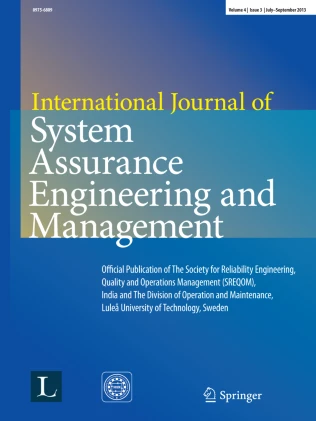
International Journal of System Assurance Engineering and Management is a peer-reviewed scholarly journal that provides a comprehensive platform for the modeling, analysis, and management of large-scale engineering systems. Published by Springer Nature in collaboration with international academic and professional bodies, the journal focuses on advancing knowledge in system assurance by integrating engineering reliability, quality management, and operational efficiency. With a strong commitment to academic rigor, the journal publishes twelve issues annually, ensuring continuous dissemination of high-quality research.
The journal emphasizes both theoretical innovation and practical relevance, encouraging contributions that address real-world engineering challenges. It serves as an important resource for researchers, engineers, and practitioners by offering insights into modern tools, methodologies, and technologies used in complex system design and management. Through rigorous peer review and global indexing, the journal maintains high standards of scientific credibility and international visibility.
Aims and Scope
The primary aim of the journal is to promote research in system assurance engineering, particularly focusing on the integration of diverse and heterogeneous technologies to solve complex engineering problems. It seeks to bridge the gap between theory and practice by publishing studies that combine analytical modeling, technological innovation, and management strategies. The journal supports interdisciplinary approaches that enhance system reliability, safety, risk assessment, and performance optimization across various engineering domains.
Its scope includes emerging and advanced areas such as artificial intelligence, machine learning, deep learning, natural language processing, Industrial Internet of Things (IIoT), and augmented reality, among others. By welcoming contributions from both academia and industry, the journal fosters innovation in engineering systems and management practices. It aims to support the development of efficient, resilient, and intelligent systems that meet the evolving demands of modern technological and industrial environments.