In the early days of scientific discovery, research was often a solitary pursuit. Scientists would spend months or even years conducting experiments, analyzing data, and only then sharing their findings with the wider community. However, the advent of “big science” has transformed this approach, emphasizing the power of collaboration. Today, research is rarely a one-person endeavor. Complex global challenges—from climate change and public health crises to technological innovation—demand collective expertise and cross-disciplinary efforts. Collaboration has become the cornerstone of modern research, enabling knowledge to advance faster and more effectively.
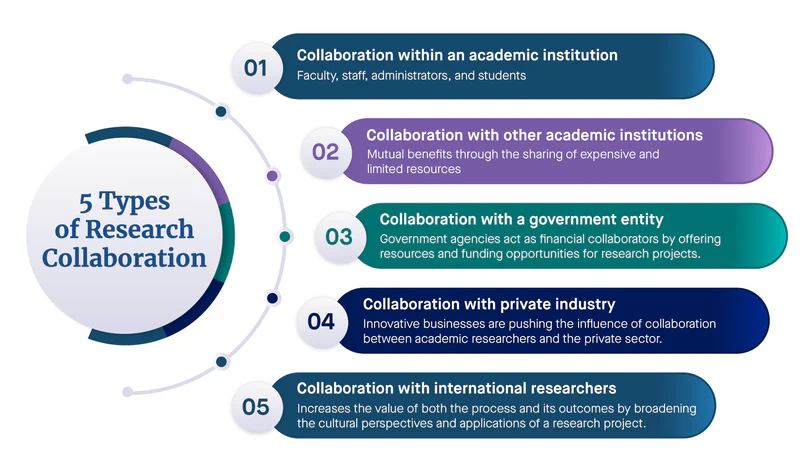
1️⃣ Collaboration within an Academic Institution 🏛️
Collaboration within a single university or research institution forms the foundation of academic teamwork. Faculty members, administrative staff, and students work together to address research questions, leveraging their combined skills and resources. Teams may form within a single department or span multiple disciplines, encouraging creative problem-solving and innovation. One of the greatest advantages of internal collaboration is the ease of communication. Face-to-face meetings allow for quick idea exchange, immediate feedback, and real-time adjustments to research design or methodology. Moreover, the close-knit environment fosters mentorship, skill development, and a sense of shared purpose among team members.
2️⃣ Collaboration Between Academic Institutions 🎓🤝🎓
When universities join forces, the possibilities for research expand significantly. Inter-institutional collaboration allows for resource sharing, access to larger and more diverse participant pools, and enhancement of research quality through combined expertise. For junior researchers, these collaborations provide invaluable experience and professional credibility, while senior researchers benefit from fresh perspectives and innovative approaches. Often, such collaborations are facilitated by funded projects led by primary investigators, creating structured opportunities for teamwork across campuses and regions. These partnerships not only advance individual projects but also strengthen the overall academic network, paving the way for future collaborative endeavors.
3️⃣ Collaboration with Government Entities 🏛️📊
Governments are essential partners in research, particularly in areas that influence public policy such as healthcare, education, and environmental sustainability. Through collaboration, researchers can provide scientific expertise that informs decision-making, while governments offer funding and strategic direction. Opportunities exist on both sides: governments may invite researchers to investigate pressing societal issues, and researchers can propose studies that address national or global priorities. This form of collaboration ensures that research has a tangible impact on society, bridging the gap between scientific knowledge and policy implementation.
4️⃣ Collaboration with Private Industry 💼📈
Partnerships with private companies open new avenues for applied research and technological innovation. Businesses collaborate with researchers to develop products, enhance processes, and create solutions that are both scientifically sound and commercially viable. For researchers, these collaborations provide funding and access to real-world applications of their work. For companies, the benefits include cutting-edge expertise, evidence-based innovation, and competitive advantage in their industries. Such collaborations create a symbiotic relationship where academic research and industry needs meet, resulting in practical solutions that can drive economic growth and societal advancement.
5️⃣ Collaboration with International Researchers 🌎🔗
Global collaboration expands the horizons of research by integrating diverse cultural perspectives and addressing worldwide challenges. International partnerships often arise through conferences, exchange programs, or shared research interests. By working across borders, researchers break down political, geographical, and institutional barriers, fostering a global scientific community. The cross-cultural exchange of ideas enhances the quality and relevance of research, promotes inclusivity, and ensures that solutions have a broader, international impact. In today’s interconnected world, international collaboration is essential for tackling issues that no single country can solve alone.
🗣️ Communication: The Key to Successful Collaboration
Effective collaboration hinges on clear and consistent communication. While face-to-face meetings remain invaluable for in-depth discussions and brainstorming, digital tools such as video calls, emails, and collaborative platforms help bridge distances when partners are separated geographically. Regular updates, shared goals, and transparent feedback ensure that collaborations remain productive from project inception to publication.
💡 The Bottom Line
Collaboration is not just a trend; it is the future of research. By working together, researchers can drive innovation, cross disciplinary boundaries, and develop solutions with meaningful global impact. When minds unite, knowledge multiplies, and the potential for scientific breakthroughs becomes limitless.
💬 Have you experienced research collaboration or are you eager to explore it? Share your experiences and aspirations in the comments! 👇