
Artificial Intelligence (AI) is reshaping how researchers write, analyze, and publish academic work. From generating summaries to improving clarity, AI can be a powerful tool in your research journey. However, excessive dependence on AI tools can increase similarity scores and reduce originality — a serious concern in academic publishing. Here’s how to use AI responsibly while maintaining the integrity and uniqueness of your research paper.
- Understand AI’s Strengths and Limitations
AI tools are helpful, but they’re not perfect. Knowing what they can and cannot do will help you use them effectively.
✅ AI excels at:
- Summarizing complex content.
- Paraphrasing or rewording text.
- Generating drafts and identifying textual patterns.
❌ AI struggles with:
- Deep understanding: AI doesn’t truly comprehend complex theories or abstract concepts.
- Nuanced arguments: It often misses subtle meanings or critical distinctions.
- Originality: AI relies on existing data and cannot produce genuinely novel insights.
- Use AI as a Tool, Not a Replacement
Think of AI as an assistant, not an author. Use it to enhance your research process rather than to replace your intellectual input.
🔹 For drafting: Brainstorm ideas, create outlines, and overcome writer’s block.
🔹 For editing: Improve grammar, refine clarity, and enhance readability.
🔹 For research: Summarize relevant literature and identify trends — but always verify facts from credible academic sources.
- Emphasize Human Creativity
💡 Your creativity is what makes your research truly original.
- Formulate unique arguments and research questions.
- Use AI-generated drafts only as a starting point, then rewrite and expand them with your own insights.
- Conduct original analysis or experiments to add new contributions to your field.
- Cite and Attribute Properly
📜 Transparency is essential for academic integrity.
- Acknowledge any AI contributions or tools used (e.g., ChatGPT, Grammarly).
- Properly cite all external sources, including AI-assisted summaries or paraphrases.
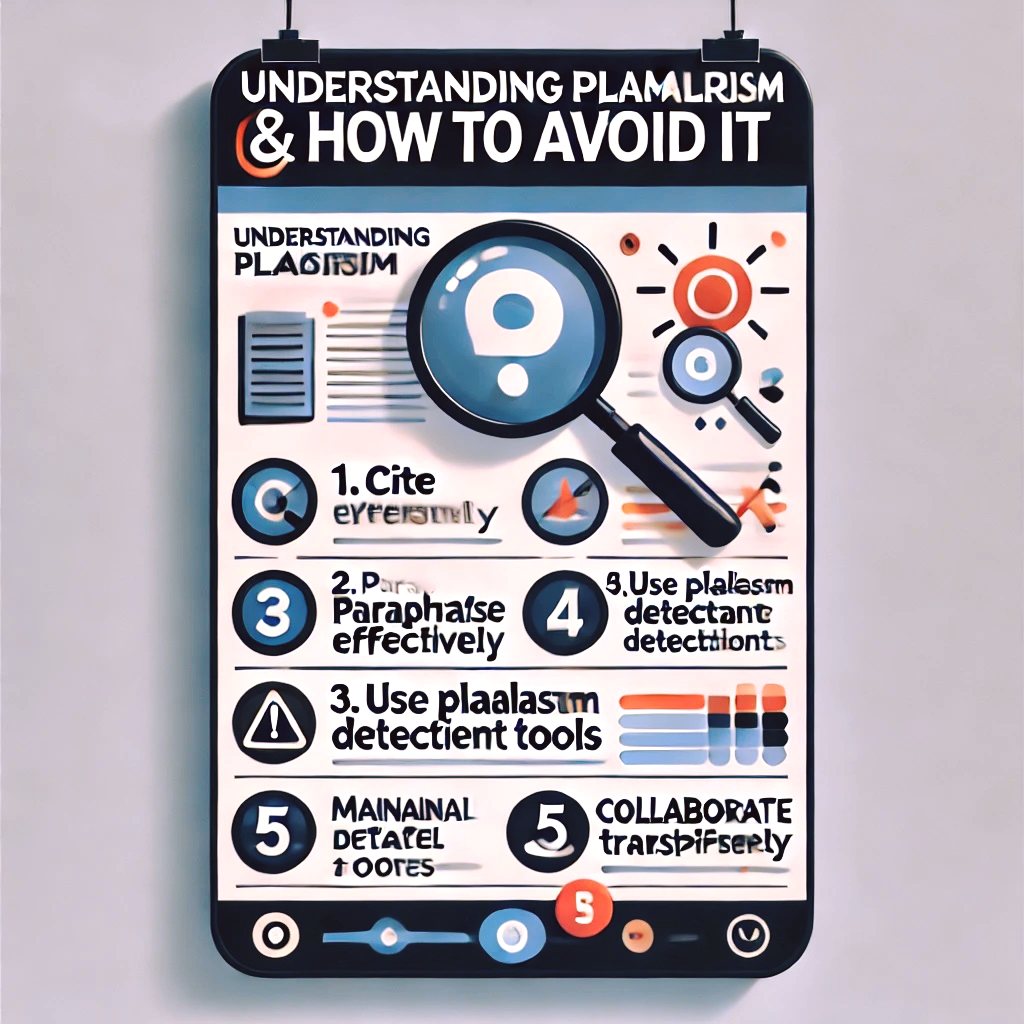
- Always paraphrase content thoughtfully to avoid unintentional plagiarism.
- Refine and Edit Carefully
🖋️ Go beyond superficial changes to ensure your writing reflects your authentic voice.
- Reorganize and rephrase content to sound natural and human-written.
- Use plagiarism checkers like Turnitin or Quetext to confirm originality.
- Seek peer feedback or professional proofreading to further reduce AI-like phrasing.
- Focus on Deep Learning
📘 The best way to write original research is to understand deeply.
- Study your topic thoroughly.
- Develop critical thinking and analytical reasoning to interpret data meaningfully.
- Draw on your own experiences, case studies, or cultural perspectives to enrich your arguments.
- Stay Informed about AI Developments
🔍 AI in academia is evolving rapidly.
- Keep track of new tools, ethical guidelines, and university policies on AI use.
- Use AI responsibly to support — not substitute — your intellectual contributions.
Final Thoughts
AI can make your research process smarter and more efficient — but it cannot replace your originality, creativity, and analytical depth. By balancing technology with human intellect, you can create research that is both innovative and authentic.
Need Help Reducing AI Similarity or Improving Originality?
At PAK Ink Publications, we specialize in helping researchers produce authentic, plagiarism-free, and publication-ready manuscripts.
Our services include:
- AI similarity reduction and original rewriting.
- Proofreading and editing for clarity and structure.
- Citation and formatting assistance in all academic styles.
- Research guidance for originality and ethical writing.
📩 Contact us: pakinkpub@gmail.com
🌐 Facebook: @pakinkpub
📸 Instagram: @pakinkpub