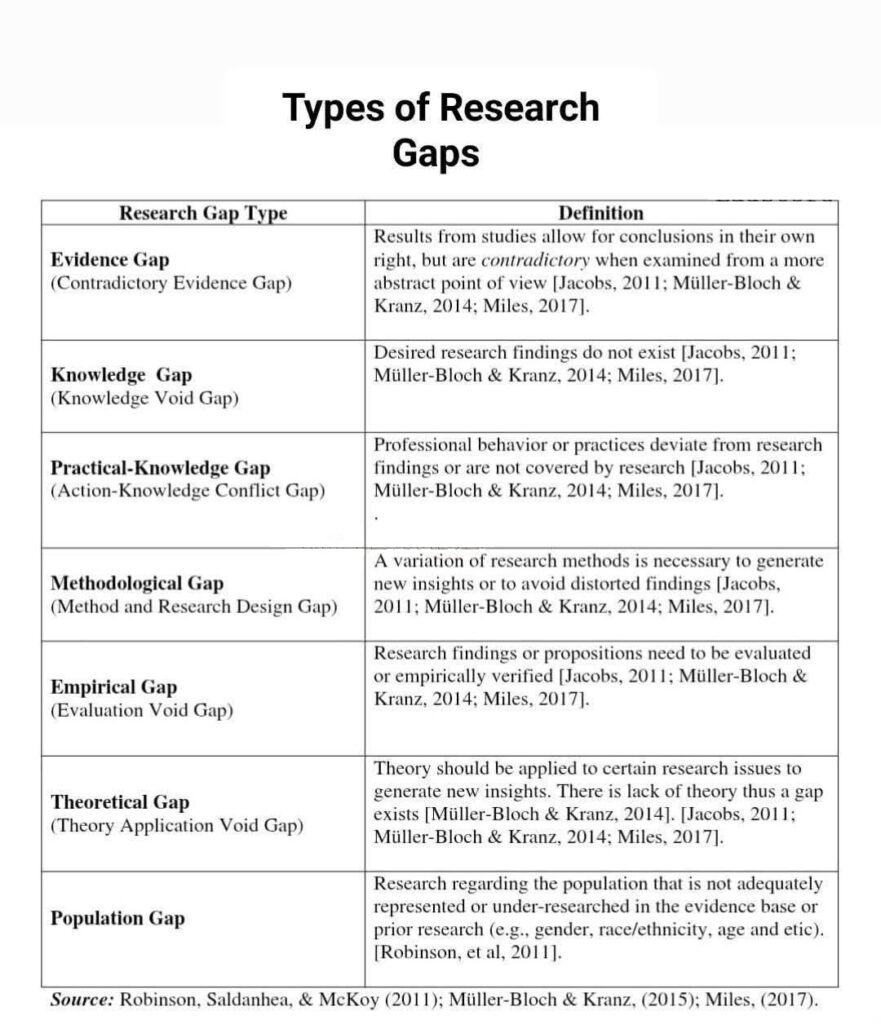
Identifying research gaps is a crucial step in conducting impactful and original research. Recognizing these gaps not only sharpens your focus but also ensures that your study contributes meaningful insights to your field. Here’s an overview of the 7 key types of research gaps every researcher should be aware of.
1️⃣ Evidence Gap
An evidence gap arises when existing studies produce contradictory or inconsistent findings. Addressing these discrepancies through further research helps clarify outcomes and strengthens the reliability of knowledge in the field.
2️⃣ Knowledge Gap
A knowledge gap occurs when there is little or no research available on a specific topic or area. Identifying these gaps provides opportunities to explore uncharted territory and generate new insights.
3️⃣ Practical-Knowledge Gap
Sometimes research findings do not align with real-world practices. A practical-knowledge gap highlights the need to bridge theory and application, ensuring that academic insights are relevant and actionable.
4️⃣ Methodological Gap
A methodological gap exists when there is a need for new research methods, improved designs, or innovative approaches. This type of gap encourages researchers to adopt novel techniques or refine existing methodologies.
5️⃣ Empirical Gap
An empirical gap arises when findings require further validation or verification through additional studies. Conducting empirical research ensures that conclusions are backed by robust evidence.
6️⃣ Theoretical Gap
A theoretical gap is present when there is a lack of theoretical framework or application in existing research. Addressing this gap contributes to the development and testing of theories in the field.
7️⃣ Population Gap
A population gap occurs when certain groups, demographics, or regions are underrepresented in research. Focusing on these populations ensures inclusivity and enhances the generalizability of findings.
💡 The Bottom Line
Understanding and identifying research gaps is essential for defining a strong research problem. By addressing these gaps, researchers can contribute valuable knowledge, advance their field, and create studies with high academic impact.
📌 Follow @PAKInkPub for more research tips, academic guidance, and support for publishing your work!