Submitting your PhD or DBA thesis is one of the most critical moments in your academic journey. After years of research, writing, and revisions, everything comes down to one key question:
👉 Have you actually checked what examiners are looking for?
Many researchers focus heavily on writing and formatting—but overlook the deeper evaluation criteria used by examiners. The difference between a pass and a fail often lies in a few critical areas that determine the strength, clarity, and impact of your research.
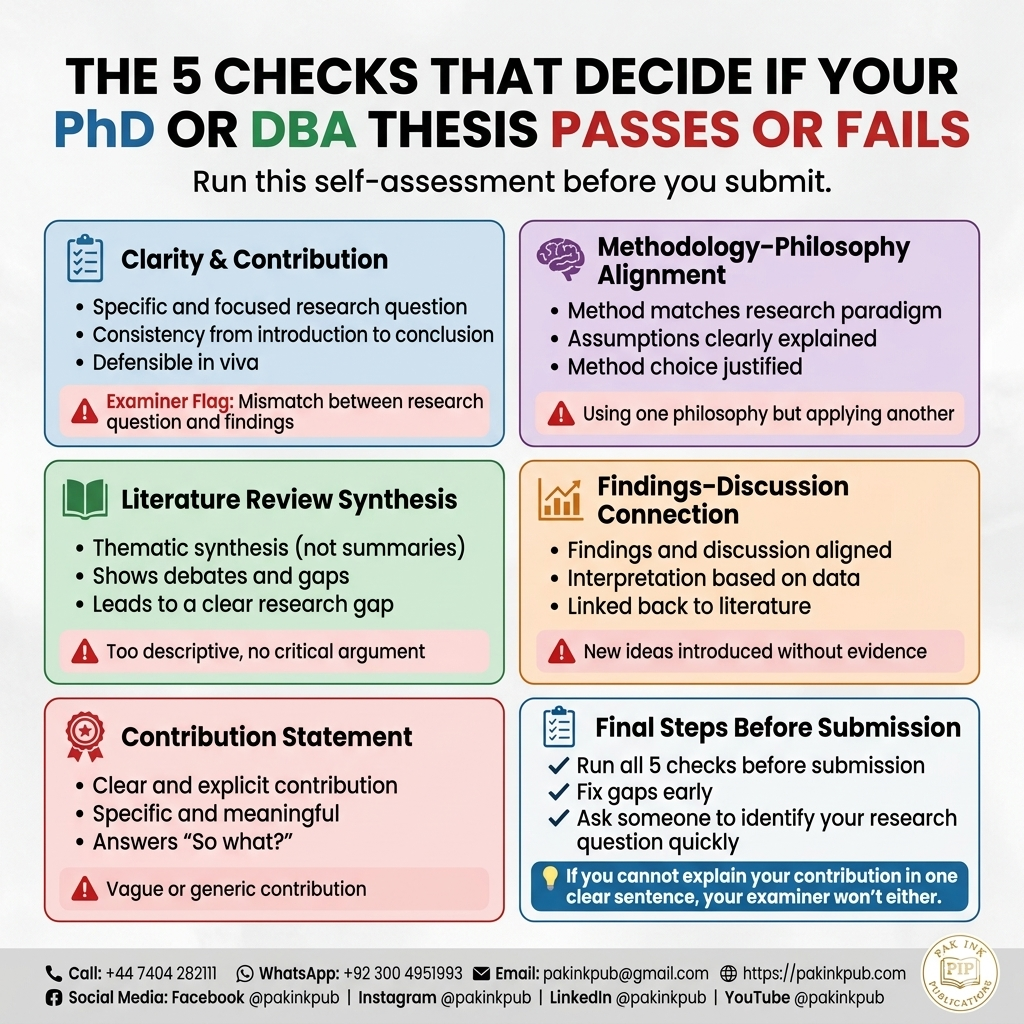
This blog presents a powerful 5-step self-assessment framework that every researcher should apply before submitting their thesis.
🔍 1. Clarity & Contribution
Your thesis must clearly communicate what your research is about and why it matters.
Ask yourself:
- Is your research question specific, focused, and well-defined?
- Is your argument consistent from the introduction through to the conclusion?
- Can you confidently defend your research in a viva or oral examination?
💡 Insight: A strong thesis tells a clear and coherent story. If your argument is confusing or inconsistent, examiners will struggle to understand your contribution.
⚖️ 2. Methodology–Philosophy Alignment
One of the most overlooked aspects of research is the alignment between your methodology and your research philosophy.
Check the following:
- Does your chosen method align with your research paradigm (e.g., positivist, interpretivist)?
- Have you clearly explained your philosophical assumptions?
- Have you justified why your methodological choices are appropriate?
💡 Insight: Misalignment between philosophy and methodology is a major red flag for examiners and can significantly weaken your study.
📚 3. Literature Review Synthesis
A strong literature review goes beyond summarizing studies—it builds a critical argument.
Evaluate your review:
- Are you organizing literature into themes rather than listing studies?
- Do you highlight debates, contradictions, and critical perspectives?
- Does your review clearly lead to a meaningful research gap?
💡 Insight: Your literature review should demonstrate your expertise and justify the need for your research.
🔗 4. Findings–Discussion Connection
Your findings and discussion must work together seamlessly.
Ask yourself:
- Do your findings align with your discussion?
- Are your interpretations clearly grounded in your data?
- Do you connect your results back to existing literature?
💡 Insight: Introducing new ideas in the discussion that are not supported by your data is a common and serious mistake.
🧩 5. Contribution Statement
Your contribution is the most important part of your thesis—yet it is often poorly presented.
Make sure:
- Your contribution is clearly stated (not hidden in the text)
- It is specific, original, and meaningful
- It answers the critical question: “So what?”
💡 Insight: If your contribution is vague, your research impact becomes unclear—no matter how much effort you’ve put in.
🚨 Common Examiner Red Flags
Examiners are trained to quickly identify weaknesses in a thesis. Be aware of these common red flags:
- Misalignment between research questions and findings
- Weak or unclear theoretical positioning
- Descriptive literature review with no critical analysis
- Discussion that introduces unsupported ideas
- Vague or unclear contribution statements
Avoiding these issues can significantly improve your chances of success.
📌 Before You Submit Your Thesis
Before final submission, take time to critically evaluate your work:
✔ Apply all 5 checks to your thesis
✔ Identify and fix gaps before examiners do
✔ Ask someone to locate your research question within 2 minutes
💡 Quick Test:
If someone cannot quickly understand your research focus, your clarity needs improvement.
❓ The Ultimate Self-Test
Here’s the most powerful test of all:
👉 Can you explain your research contribution in one clear sentence?
If the answer is no, your thesis likely lacks clarity—and examiners will notice it too.
📢 Need Expert Research Assistance?
Preparing a thesis for submission can be overwhelming, especially when aiming for high academic standards. Professional guidance can help you refine your work and avoid critical mistakes.
PAK Ink Publications provides expert support at every stage of your research journey—from thesis development and methodology design to final editing and publication. Our goal is to ensure your work meets international standards and achieves the success it deserves.
📞 Contact Us
Call: +44 7404 282111
WhatsApp: +92 300 4951993
Email: pakinkpub@gmail.com
🌐 Connect With Us
Website: https://pakinkpub.com
Facebook | Instagram | LinkedIn | YouTube: @pakinkpub
🔑 Final Thoughts
Your thesis is more than a document—it represents years of effort, learning, and intellectual growth. Ensuring that it meets examiner expectations is crucial for your academic success.
By applying these five essential checks, you can strengthen your research, eliminate weaknesses, and confidently move toward a successful submission.
Take the time to review, refine, and perfect your thesis—because small improvements can make the difference between pass and fail.