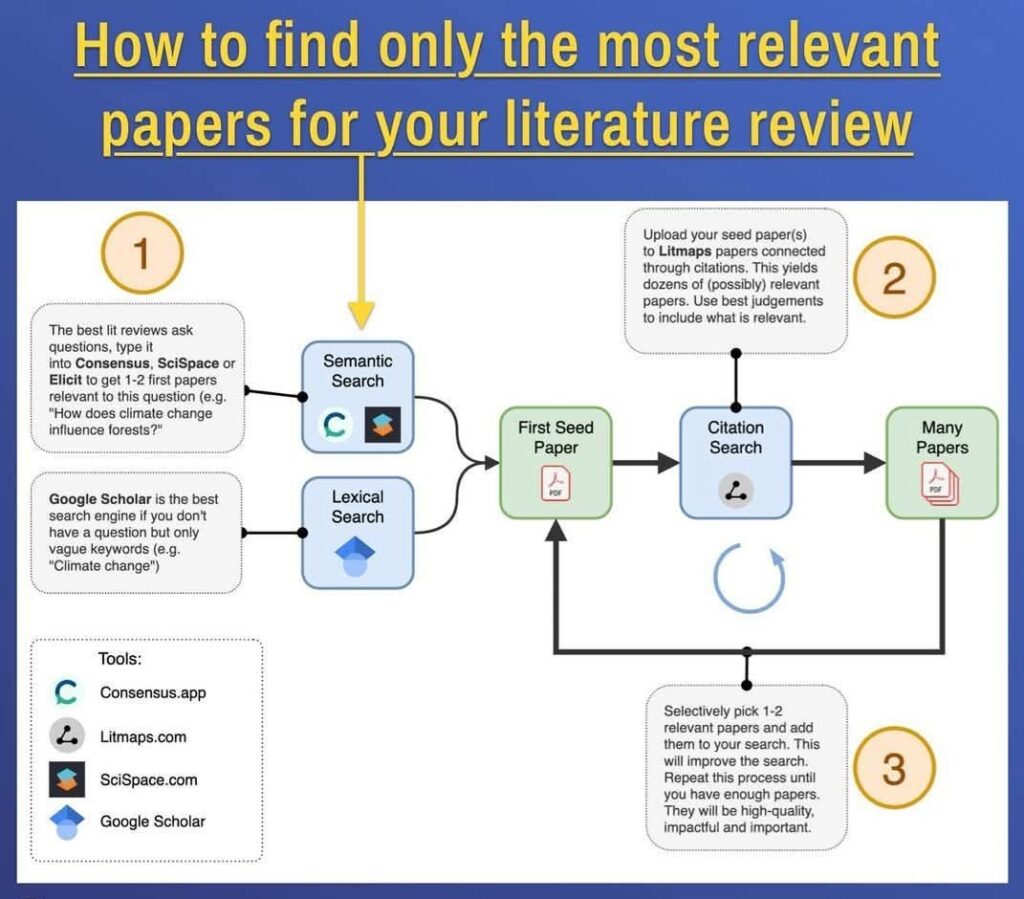
Conducting a literature review can be overwhelming, especially when faced with thousands of research papers and articles. The key to a successful review is finding the most relevant and high-quality studies that directly contribute to your research topic. Here’s a detailed guide to streamline your search, save time, and ensure your review is comprehensive and up-to-date.
1️⃣ Define Clear Keywords
Start by breaking down your research topic into specific keywords and phrases. Think about the main concepts, variables, and populations relevant to your study. Use Boolean operators such as AND, OR, and NOT to combine or exclude terms for more precise search results. For example, if your topic is “social media influence on youth mental health,” try combinations like “social media AND adolescent AND mental health” or exclude irrelevant terms with “NOT adults.” Clear keywords are the foundation of an effective literature search.
2️⃣ Use Academic Databases
Rely on trusted academic databases to access peer-reviewed and credible research. Platforms such as Scopus, Web of Science, PubMed, Google Scholar, and JSTOR are excellent starting points. Use the advanced search options to filter results by publication year, field, document type, or language. Filtering ensures you focus only on studies that are most relevant to your research questions, saving time and improving quality.
3️⃣ Sort by Citations and Relevance
Highly cited papers often contain key foundational insights and are widely recognized in the field. Begin by prioritizing these papers, as they often serve as a backbone for understanding your topic. Check sections like “Cited By” or “Related Articles” to discover additional studies that may be directly relevant. This approach helps build a strong foundation for your review and ensures you include influential research.
4️⃣ Check Abstracts First
Before reading full papers, skim the abstracts to determine if a study aligns with your research objectives. Abstracts summarize the purpose, methodology, key findings, and conclusions of a study, allowing you to quickly evaluate relevance. This strategy saves time and prevents unnecessary reading of unrelated articles.
5️⃣ Focus on Recent Studies
Prioritize research from the last 5–10 years to ensure your literature review reflects current trends, findings, and debates in your field. While older studies may provide foundational context, emphasizing recent work demonstrates that your research is informed by the latest evidence.
6️⃣ Leverage Review Papers
Review articles and systematic reviews summarize multiple studies in a specific area, highlighting key trends, gaps, and debates. These papers are invaluable for identifying influential research, understanding the state of the field, and finding references to both foundational and recent studies. Including review papers can greatly enhance the quality and depth of your literature review.
💡 Tip: Stay Organized
Keep track of all your sources using reference management tools like Mendeley, Zotero, or EndNote. Organizing references efficiently allows you to cite accurately, avoid plagiarism, and streamline the writing process.
Need Assistance?
The literature review is critical, but it doesn’t have to be stressful. At PAK Ink Publications (PIP), we help researchers:
✅ Select, organize, and summarize the most relevant research papers.
✅ Publish in HEC-approved W, X, and Y category journals, indexed in Scopus and Web of Science.
✅ Collaborate on social sciences research projects, with co-authorship opportunities in reputable journals.
Contact Us:
📩 Email: pakinkpub@gmail.com
🌐 Facebook: @pakinkpub
📸 Instagram: @pakinkpub
Let us help you make your literature review stress-free, accurate, and impactful! 🚀