One of the most overlooked reasons for research paper rejection is not weak data, poor methodology, or lack of originality—it’s something far more basic: incorrect tense usage in academic writing.
Many researchers spend months perfecting their data, analysis, and results. Yet, they unintentionally weaken their work by using the wrong tenses, leading to confusion, reduced clarity, and unnecessary revisions.
In this guide, we’ll explain how to use the correct tense in each section of a research paper so you can improve your chances of publication in Scopus and Web of Science indexed journals.
Why Tense Matters in Academic Writing
Using the correct tense in research writing is not just about grammar. It directly affects clarity, precision, and professionalism.
Incorrect tense usage can confuse peer reviewers, disrupt the logical flow of your paper, make your research appear less credible, and increase the chances of rejection or major revisions.
Strong research is not just about what you write. It’s about how you present it.
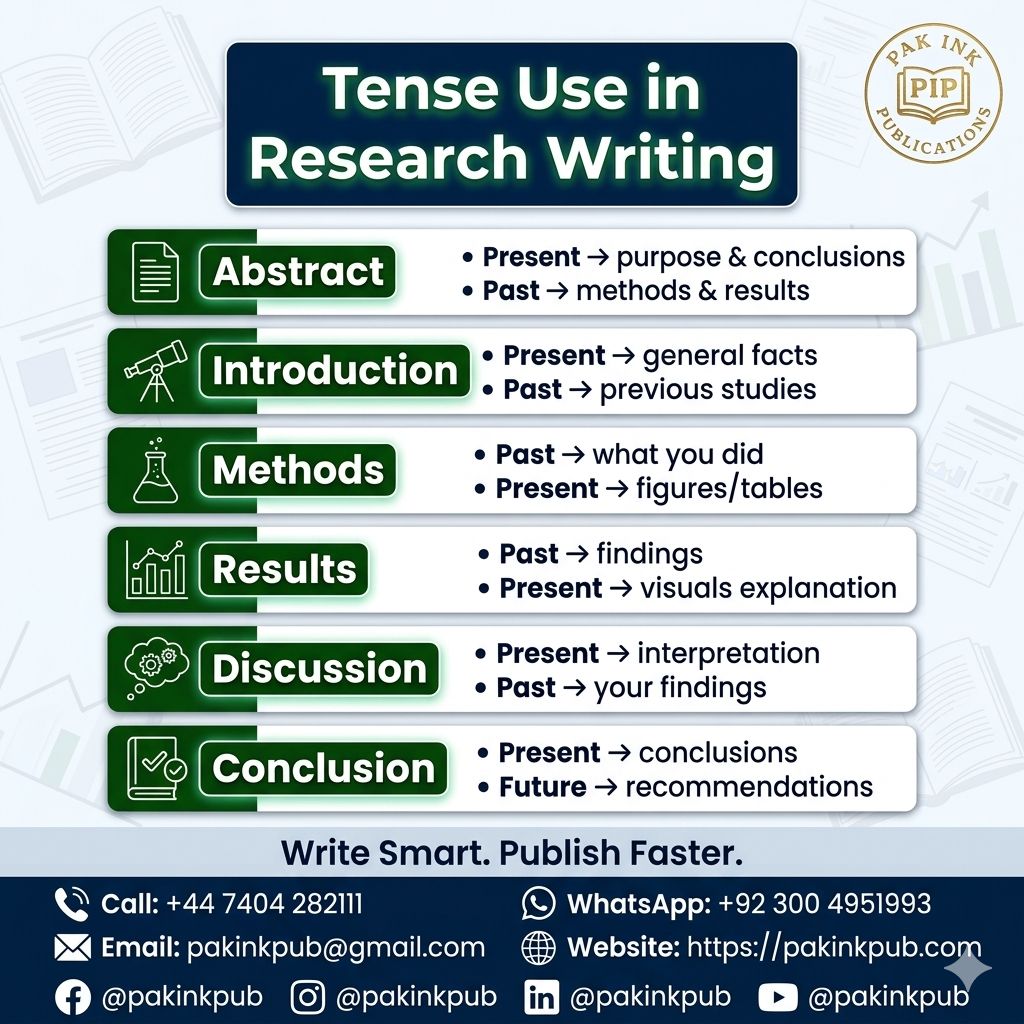
Correct Tense Usage in Each Section of a Research Paper
Understanding where and how to use tenses can significantly improve your manuscript quality.
Abstract: A Balanced Use of Tenses
Use present tense for the purpose and conclusions, and past tense for methods and results.
Introduction: Present the Field, Reference the Past
Use present tense for general facts and theories, and past tense for previous studies.
Methods: What You Did
Use past tense to describe procedures and experiments. Present tense may be used when referring to figures or tables.
Results: What You Found
Use past tense for findings and present tense when explaining tables or figures.
Discussion: Interpreting the Findings
Use present tense for interpretation and past tense for referring to results.
Conclusion: Final Thoughts and Future Direction
Use present tense for conclusions and future tense for recommendations.
Common Mistakes Researchers Make
Many researchers mix tenses within the same sentence, use present tense for completed actions, or remain inconsistent across sections. Ignoring journal guidelines is another major issue.
These mistakes can make your paper look unprofessional, even when your research is strong.
How to Improve Your Academic Writing
Review each section carefully for tense consistency. Follow your target journal’s guidelines, especially for Scopus and Web of Science publications. Reading published papers in your field can also help you understand proper usage.
Professional editing and expert feedback can significantly improve your chances of acceptance.
Why Expert Guidance Matters
At PAK Ink Publications, we guide researchers not just in publishing but in writing their papers the right way. From correct tense usage to journal selection, we help you avoid rejection and publish with confidence.
Final Thoughts
Using the correct tense may seem like a small detail, but in academic publishing, small details make a big difference.
If your goal is to publish in high-quality indexed journals, mastering tense usage is essential.
Frequently Asked Questions (FAQs)
What tense should be used in a research paper?
Different sections require different tenses. Present tense is used for general facts and conclusions, past tense for methods and results, and future tense for recommendations.
Can I mix tenses in a research paper?
Yes, but only when appropriate. Each section has its own standard tense usage. Random or incorrect mixing can confuse reviewers.
Why do journals reject papers due to tense issues?
Incorrect tense usage reduces clarity and professionalism, making it harder for reviewers to understand your research.
Is tense important for Scopus and Web of Science journals?
Yes, both Scopus and Web of Science journals expect high-quality academic writing, including correct grammar and tense usage.
How can I improve tense usage in my paper?
You can improve by reviewing published papers, following journal guidelines, and seeking professional editing support.