The Core Purpose
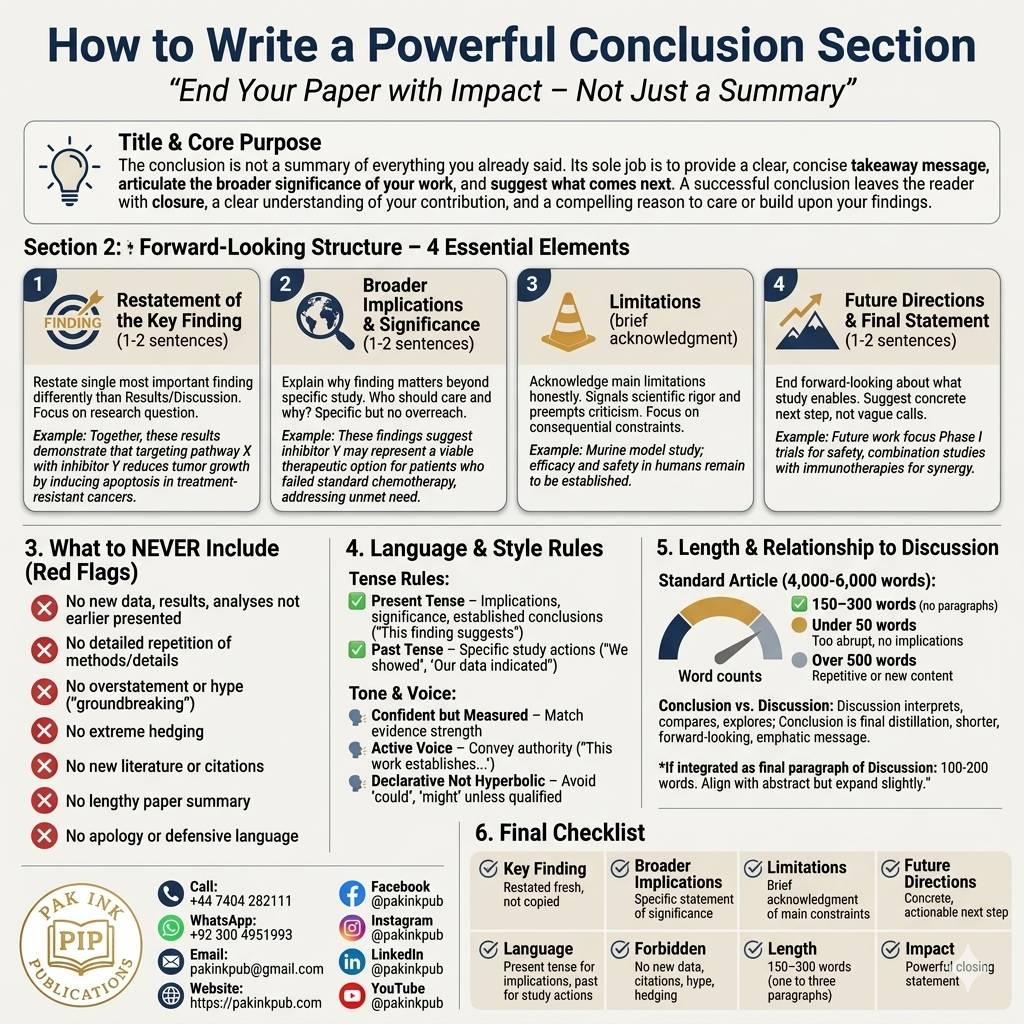
The conclusion is not a summary of everything you already said. Its sole job is to provide a clear, concise takeaway message, articulate the broader significance of your work, and suggest what comes next. A successful conclusion leaves the reader with a sense of closure, a clear understanding of what the study contributes, and a compelling reason to care about or build upon the findings.
What MUST Be in a Good Conclusion Section (The Forward-Looking Structure)
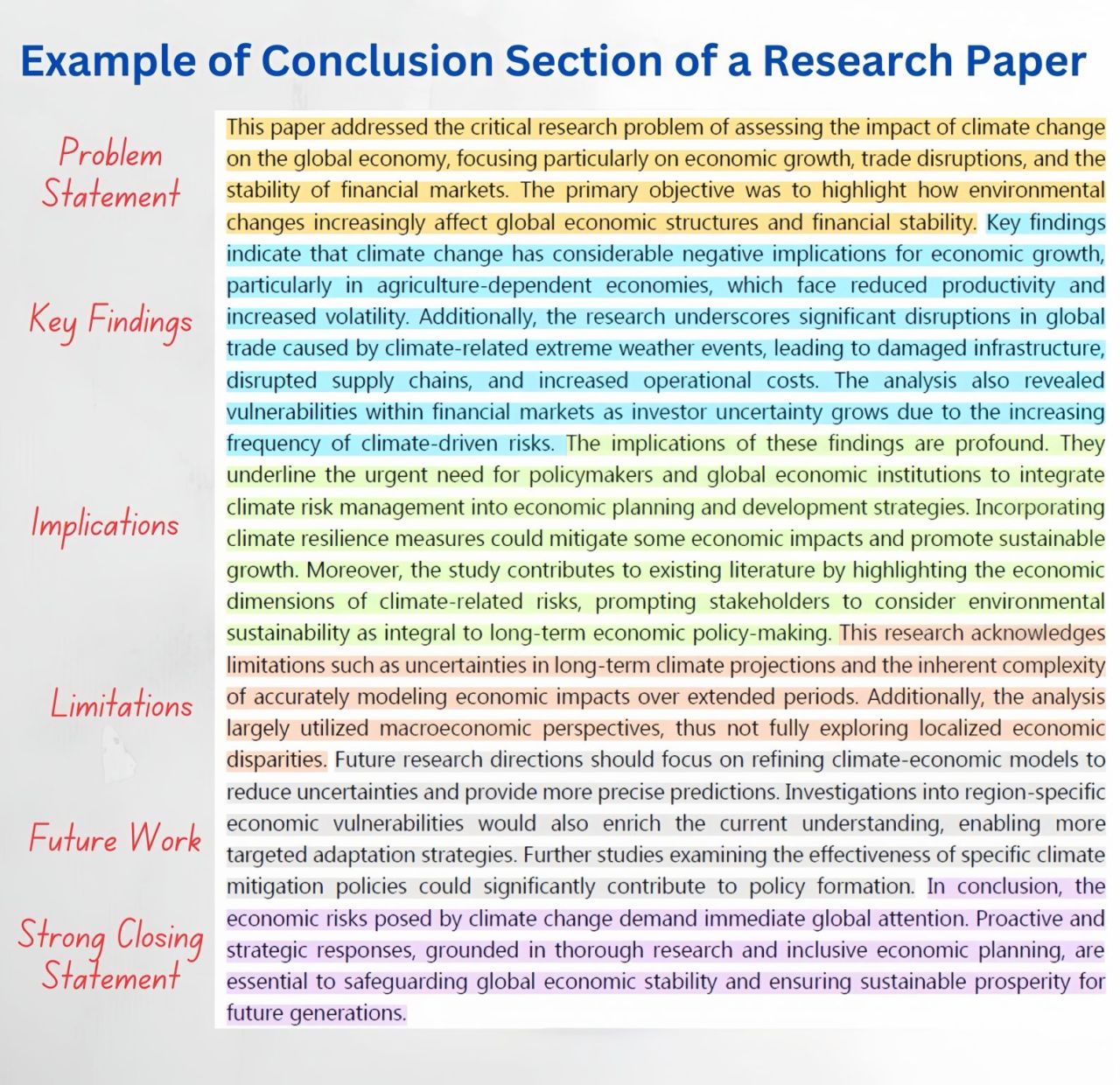
A strong conclusion is concise and focused, typically the final paragraph or two of the Discussion. It should contain four essential elements. 1) Restatement of the Key Finding (1-2 sentences): Begin by restating the single most important finding of your study, phrased differently than in the Results or Discussion opening. Do not list all findings; focus on the core answer to your research question. Example: “Together, these results demonstrate that targeting pathway X with inhibitor Y reduces tumor growth by inducing apoptosis in treatment-resistant cancers.” 2) Broader Implications & Significance (1-2 sentences): Explain why this finding matters beyond your specific study. Who should care and why? What is the conceptual, clinical, practical, or policy implication? Be specific but do not overreach beyond what your data support. Example: “These findings suggest that inhibitor Y may represent a viable therapeutic option for patients who have failed standard chemotherapy, addressing a critical unmet clinical need.” 3) Limitations (often placed before the conclusion or briefly acknowledged within it): Acknowledge the main limitations of your study briefly and honestly. This signals scientific rigor and preempts criticism. Avoid an exhaustive list; focus on the most consequential constraints that affect interpretation or generalizability. Example: “While these results are promising, the study was conducted in a murine model; efficacy and safety in humans remain to be established.” 4) Future Directions & Final Statement (1-2 sentences): End with a forward-looking statement about what this study enables or what questions remain. This can be a specific next step, a broader research agenda, or a final thought that crystallizes the contribution. Avoid vague calls for “more research.” Instead, suggest a concrete direction. Example: “Future work should focus on Phase I clinical trials to assess safety, as well as combination studies with existing immunotherapies to evaluate synergistic effects.”
What MUST NOT Be in a Good Conclusion Section
No new data, results, or analyses that were not presented earlier. No detailed repetition of methods or experimental details. No extensive discussion of individual findings (that belongs in the main Discussion). No overstatement or hype (e.g., “This groundbreaking study revolutionizes the field”). No hedging so extreme that it undermines your contribution (e.g., “These findings might perhaps suggest a possible trend toward a potential implication”). No introduction of new literature or citations not discussed earlier. No lengthy summary of the entire paper (the conclusion is not an abstract). No speculation that is not grounded in your findings. No apology or defensive language (e.g., “We acknowledge that this study is far from complete”).
What Kind of Language Should Be Used?
Use present tense for implications, significance, and established conclusions (e.g., “This finding suggests,” “The mechanism is,” “These results demonstrate”). Use past tense when referring to your specific study actions (e.g., “We showed that,” “Our data indicated”). Use confident but measured language that matches the strength of your evidence. Avoid conditional language like “could,” “might,” or “may” unless appropriately qualified. Be declarative but not hyperbolic. Use active voice to convey authority and clarity (e.g., “This work establishes a framework for…” rather than “A framework for… is established by this work”).
Complementary Elements (What is Often Included or Excluded)
Included are a clear statement of the study’s contribution (often framed as “In summary,” “Collectively,” or “Taken together”), a concise acknowledgment of the most important limitation, and a concrete future direction. Included also, for some journals, a separate “Conclusions” section heading that distinguishes it from the broader Discussion. Excluded from the conclusion are any figures or tables, extensive citations, detailed methodological descriptions, or any element that belongs in earlier sections. Excluded are acknowledgments of funding or contributions (those belong in a separate Acknowledgments section after the conclusion).
How the Conclusion Differs from the Discussion
The Discussion section interprets results, compares them to prior literature, explores mechanisms, acknowledges limitations in depth, and builds the argument for your conclusions. The conclusion is the final distillation of that argument. It is shorter, more focused, and forward-looking. If your Discussion is a detailed conversation about what the findings mean, the conclusion is the final sentence that summarizes the conversation’s takeaway. Many papers integrate the conclusion as the final paragraph of the Discussion; others use a separate section. Either approach is acceptable, but the conclusion must stand out as the final, emphatic message.
Length: How Long Should the Conclusion Section Be?
The conclusion should be brief, typically 150-300 words. For a standard 4,000-6,000 word research article, the conclusion as a separate section is often one to three paragraphs. If the conclusion is integrated as the final paragraph of the Discussion, it should be a concise 100-200 words. A conclusion under 50 words is too abrupt and fails to convey implications or future directions. A conclusion over 500 words likely includes repetition of material already covered in the Discussion or introduces new content. The guiding principle is brevity with impact: every sentence should serve the purpose of leaving the reader with a clear, memorable takeaway.
Relationship to the Abstract
The conclusion should align with but not simply copy the abstract. The abstract states your main finding and implication concisely. The conclusion expands slightly, situating the finding within the broader field, acknowledging limitations, and pointing to the future. A reader who reads only the abstract and the conclusion should encounter a consistent message, with the conclusion offering slightly more depth and forward-looking perspective.
Summary Checklist for a High-Quality Conclusion Section
| Element | Requirement |
| Restatement of key finding | One to two sentences presenting the core answer to your research question, phrased fresh. |
| Broader implications | Specific statement of significance, impact, or relevance beyond the study. |
| Limitations | Brief acknowledgment of the most important constraints on interpretation. |
| Future directions | Concrete, actionable next step or research agenda grounded in your findings. |
| Language | Present tense for implications, past tense for study actions; confident but measured tone. |
| Forbidden | No new data, no new citations, no hype, no extensive summary, no hedging that undermines confidence. |
| Length | 150-300 words (one to three paragraphs). |
| Relationship to Discussion | Distills the main argument rather than repeating it; serves as the final, emphatic takeaway. |
By adhering to this structure, you ensure your conclusion is not merely an afterthought but a powerful closing statement that reinforces the value of your work, earns the reader’s trust through honest acknowledgment of limitations, and invites the next generation of research to build upon your foundation.