Many researchers make a critical mistake before they even begin their study. They design experiments with uncertainty and only discover flaws after data collection has already started. This often leads to weak research design, unclear hypotheses, and wasted time. In today’s competitive academic environment, especially for those targeting Scopus and Web of Science indexed journals, a strong research design is essential from the very beginning.
Artificial Intelligence in research is changing how studies are planned and executed. Instead of jumping directly into experiments, researchers can now use AI tools to simulate outcomes, test multiple scenarios, and refine their research variables before collecting any data. This shift is revolutionizing research methodology and improving the quality of academic writing and publication success.
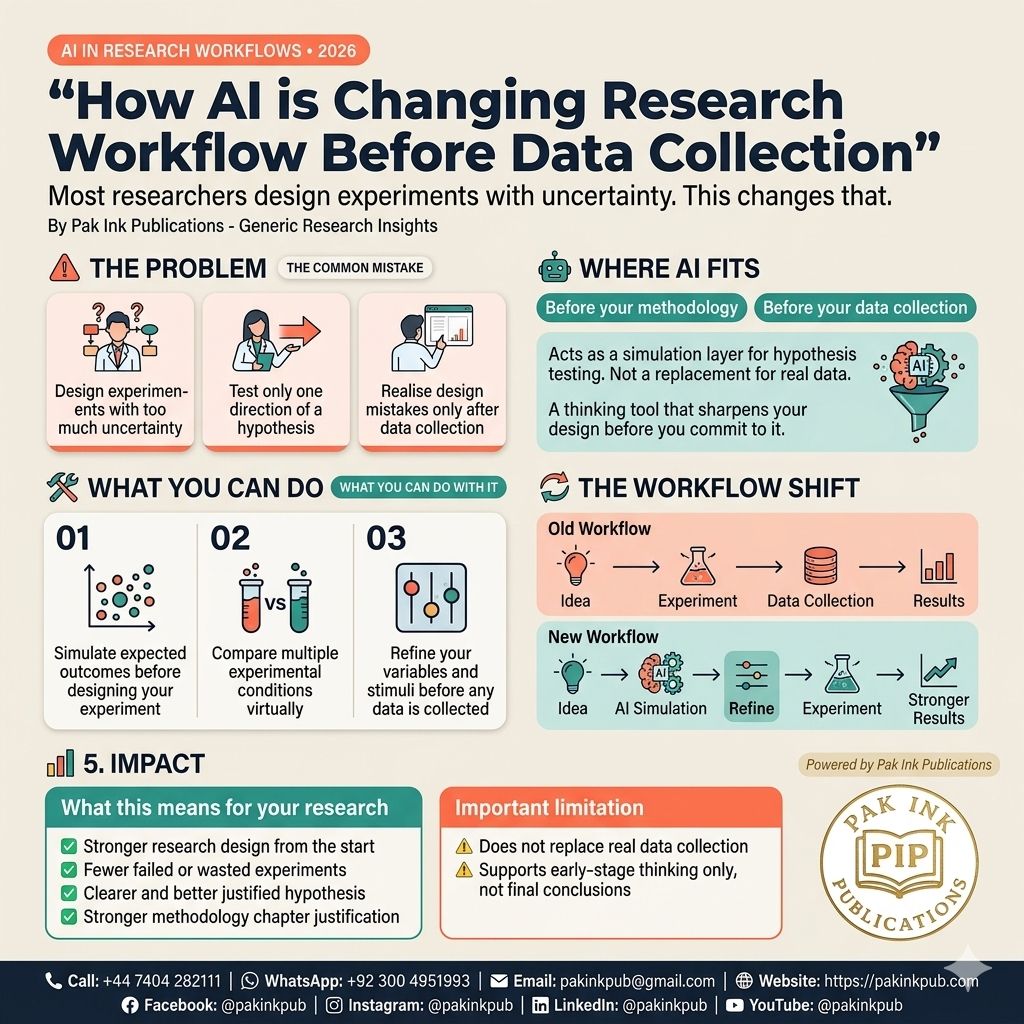
Traditionally, the research process followed a linear path: idea development, experiment design, data collection, and then results. This old approach often left little room for correcting errors in the early stages. As a result, many researchers faced rejection due to poor methodology or weak experimental design. However, the modern research workflow is evolving with the integration of AI in academic research.
The new approach is more strategic and efficient. Researchers now begin with an idea, use AI simulation tools to predict outcomes, refine their research design based on those simulations, and then move to experimentation and data collection. This improved process ensures stronger results and better alignment with research objectives. AI-driven research design allows scholars to make informed decisions before investing time and resources into data collection.
Using AI in research design offers several key advantages. It helps in building a stronger foundation for your study by identifying potential flaws early. It reduces the chances of failed or inconclusive experiments, saving both time and effort. It also enables researchers to develop clearer and more focused hypotheses, which are essential for high-impact research papers. Moreover, a well-planned methodology supported by AI insights makes your paper more convincing to journal reviewers and increases the likelihood of acceptance.
However, it is important to understand that AI is not a replacement for real data or human expertise. AI should be used as a thinking partner that enhances your decision-making process. The final results of any research still depend on actual data collection, analysis, and interpretation. Ethical use of AI in academic research is also crucial to maintain credibility and integrity.
The future of research is no longer just about collecting data. It is about thinking strategically before data collection begins. Researchers who adopt AI tools early in their workflow can significantly improve their research quality, reduce errors, and produce more impactful studies. This shift is especially important for PhD students, early-career researchers, and academics aiming to publish in high-impact journals.
If you are looking to improve your research design, academic writing, or publication success, PAK Ink Publications provides expert support tailored to international standards. From refining your research methodology to guiding you through the publication process, the right support can make a significant difference in your academic journey.