The Core Purpose
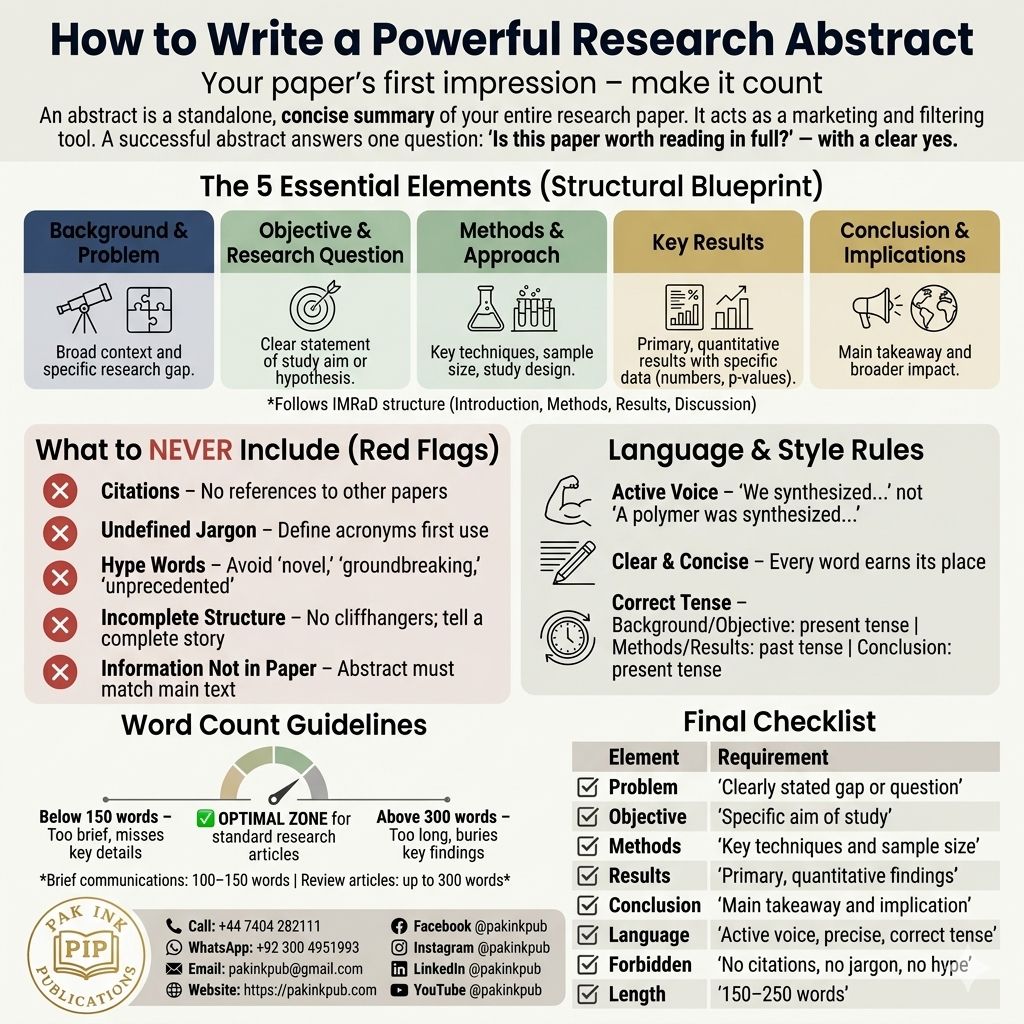
An abstract is a standalone, concise summary of your entire research paper. Its sole job is to act as a marketing and filtering tool. A reader (or journal editor) uses it to decide one thing: “Is this paper worth my time to read in full?” A successful abstract answers this question with a clear “yes.”
What MUST Be in a Good Abstract (The Structural Blueprint)
A strong abstract follows the logical structure of the paper itself. It should contain five essential elements, often corresponding to the IMRaD (Introduction, Methods, Results, and Discussion) format:
- Background & Problem (1-2 sentences): The “why.”
- What: The broad context, the specific research gap, or the problem you are addressing.
- Don’t just say: “Climate change is important.”
- Do say: “The role of aerosol-cloud interactions remains the largest source of uncertainty in climate models, particularly over the Southern Ocean where in-situ observations are scarce.”
- Objective & Research Question (1 sentence): The “what.”
- What: A clear statement of your study’s purpose, aim, or hypothesis. What did you set out to do?
- Be direct: Use phrases like “Here, we aimed to…” or “In this study, we investigate…”
- Methods & Approach (1-2 sentences): The “how.”
- What: The key techniques, materials, models, or study design. Include crucial details like sample size, duration, or key methodologies.
- Don’t be vague: “We used various methods.”
- Be specific: “We performed RNA-sequencing on tumor biopsies from 120 patients (n=60 treatment, n=60 placebo) and validated findings using an independent CRISPR-Cas9 screen.”
- Key Results (2-4 sentences): The “findings.”
- What: The most important findings of your study. This is the heart of the abstract. Report specific, quantitative data where possible (e.g., “a 40% increase,” “p < 0.001”).
- Don’t list every result. Only include the primary findings that directly support your conclusion. Avoid vague statements like “our results were interesting.”
- Conclusion & Implications (1-2 sentences): The “so what.”
- What: The main takeaway. How do your results answer the research question? What is the broader impact or significance? Avoid overreaching; state what your data actually supports.
What MUST NOT Be in a Good Abstract
- Citations: An abstract is a summary of your work, not a literature review. Never include a reference to another paper.
- Jargon & Undefined Acronyms: If you must use an acronym, define it the first time (e.g., “scanning tunneling microscopy (STM)”). Assume your reader is an intelligent scientist in your field, but not necessarily a specialist in your sub-niche.
- Details that are not essential: Leave out mundane methodological details (e.g., “we used a 1.5mL Eppendorf tube”), raw data tables, or secondary results.
- Hype & Subjective Language: Avoid words like “novel,” “groundbreaking,” “unprecedented,” or “very.” Let the strength of your data speak for itself. “Remarkably” is rarely justified.
- Incomplete Structure: An abstract is not a teaser. It must be a complete story. It should never end with a cliffhanger like “The implications of these findings are discussed.”
- Information not in the paper: Never include a result, method, or conclusion in the abstract that is not present in the main text.
What Kind of Language Should Be Used?
- Active Voice (Preferably): Active voice is more direct, concise, and engaging.
- Active (Good): “We synthesized a new polymer…”
- Passive (Weaker): “A new polymer was synthesized…”
- Clear and Concise: Every word must earn its place. Use strong, precise verbs. Replace weak phrases like “it was observed that there was an increase” with “increased.”
- Tense is Critical:
- Background/Objective: Use present tense. (“The gap is…”, “We aim to…”)
- Methods/Results: Use past tense. (“We analyzed…”, “The data showed…”)
- Conclusion: Use present tense for the established finding or its broader implication. (“Our findings suggest…”, “This mechanism is critical for…”)
Complementary Elements (What is Often Included or Excluded)
Included:
- Keywords: After the abstract, you usually list 4-6 keywords for indexing. These are not part of the abstract but are its complement.
- Funding Acknowledgment: This is not in the abstract. It belongs in a separate section after the main text.
- Trial Registration Numbers: For clinical trials, the registration number (e.g., NCT04212345) is often included at the end of the abstract.
Excluded:
- Graphical Abstracts: These are a complementary visual summary provided separately by many journals, but they do not replace the text abstract.
- Highlights: Some journals request a separate list of 3-5 bullet-point “highlights.” These are not part of the abstract.
- Author Affiliations: Listed on the title page, not in the abstract text.
The Word Count: How Long Should It Be?
The “Goldilocks” zone for a standard research article abstract is 150 to 250 words.
- Why not 50 words? A 50-word abstract (often called a “summary”) is too brief to convey the necessary context, methods, and quantitative results. It forces the author to be so vague that it fails to inform the reader or serve as a standalone summary for database searches. It tells you that something was done, but not what was found.
- Why not 400+ words? An overly long abstract defeats its purpose. It becomes a chore to read, buries the key results, and signals that the author cannot synthesize their own work. Many journals have strict limits (e.g., 250 words), and exceeding them can lead to automatic desk rejection.
General Guidelines:
- Brief Communications/Short Reports: 100–150 words.
- Standard Research Articles: 150–250 words. (This is the sweet spot for most fields like biology, chemistry, physics, medicine, and engineering).
- Review Articles: Can be slightly longer, up to 300 words, as they need to summarize a broader scope.
- Conference Abstracts: Vary wildly (from 250 to 500+ words), but follow the specific guidelines provided.
A practical tip: Write the abstract last, after the paper is complete. Then, ruthlessly edit it. Aim for the 200-word mark. If you are under 150, you are likely missing crucial details (especially quantitative results). If you are over 300, you are likely including background details, excessive methodology, or secondary findings that belong in the main text.
Summary Checklist for a High-Quality Abstract
| Problem | Clearly stated gap or question. |
| Objective | Specific aim of this study. |
| Methods | Key techniques and sample size. |
| Results | Primary, quantitative findings with stats. |
| Conclusion | Main takeaway and implication. |
| Language | Active voice, precise, correct tense. |
| Forbidden | No citations, no jargon, no hype. |
| Length | 150–250 words. |
By adhering to this structure, you ensure your abstract is not just a summary, but an effective tool that maximizes the chances of your paper being read, cited, and having impact.