The Core Purpose
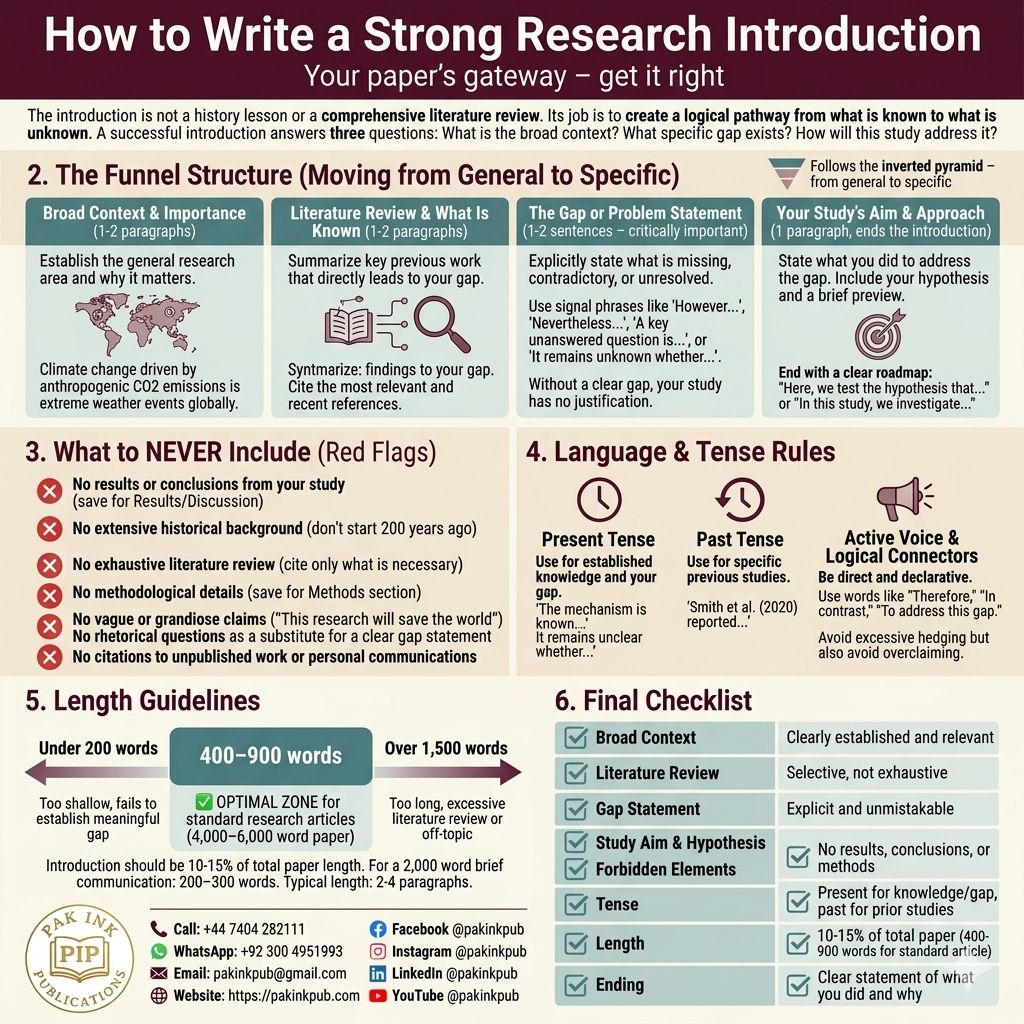
The introduction is not a history lesson or a comprehensive literature review. Its sole job is to create a logical pathway from what is already known to what is unknown, culminating in a clear statement of what you did and why. A successful introduction answers three questions for the reader: “What is the broad context? What specific problem or gap exists? And how will this study address it?”
What MUST Be in a Good Introduction (The Funnel Structure)
A strong introduction follows an inverted pyramid, moving from general to specific. It should contain four essential elements. 1) Broad Context & Importance (1-2 paragraphs): Establish the general research area, why it matters, and who cares. Example: “Climate change driven by anthropogenic CO2 emissions is intensifying extreme weather events globally.” 2) Literature Review & What Is Known (1-2 paragraphs): Summarize key previous work, but only that which directly leads to your gap. Do not list every paper; synthesize findings. Cite the most relevant and recent references. 3) The Gap or Problem Statement (1-2 sentences, critically important): Clearly and explicitly state what is missing, contradictory, or unresolved. Use signal phrases like “However…”, “Nevertheless…”, “A key unanswered question is…”, or “It remains unknown whether…” This is the hinge of your entire introduction. Without a clear gap, your study has no justification. 4) Your Study’s Aim & Approach (1 paragraph, usually ending the introduction): State what you did to address the gap. Include your hypothesis (if applicable) and a brief preview of your approach or key findings. End with a clear roadmap sentence like “Here, we test the hypothesis that…” or “In this study, we investigate…” Do not leave the reader guessing.
What MUST NOT Be in a Good Introduction
No results or conclusions from your study (save those for the Results and Discussion sections). No extensive historical background that does not lead directly to your gap (e.g., starting with the birth of the field 200 years ago). No exhaustive literature review (cite only what is necessary to establish the gap). No methodological details (save those for the Methods section). No vague or grandiose statements like “This research will save the world.” No rhetorical questions as a substitute for a clear gap statement. No citations to your own unpublished work or personal communications.
What Kind of Language Should Be Used?
Use present tense for established knowledge and your gap (e.g., “The mechanism is known…”, “It remains unclear whether…”). Use past tense for specific previous studies (e.g., “Smith et al. (2020) reported…”). Use active voice when possible, though passive voice is sometimes acceptable in background statements. Be direct and declarative. Avoid hedging excessively (e.g., “It seems possible that perhaps…”) but also avoid overclaiming. Use clear logical connectors (e.g., “Therefore,” “In contrast,” “To address this gap”).
Complementary Elements (What is Often Included or Excluded)
Included are a brief justification of why your approach is appropriate to fill the gap (e.g., “Using a longitudinal design allows us to…” ) and, for some journals, a final sentence listing what is in each subsequent section (e.g., “We describe our methods in Section 2, results in Section 3…”). Excluded from the introduction are any figures or tables (those belong in Results), detailed methodological protocols, raw data, statistical analyses, conclusions, or implications.
Length
How Long Should the Introduction Be? The introduction should typically comprise 10-15% of the total paper length. For a standard 4,000-6,000 word research article, this means 400-900 words. For a short 2,000 word brief communication, aim for 200-300 words. A good rule of thumb is 2-4 paragraphs. An introduction under 200 words likely fails to establish a meaningful gap or sufficient context. An introduction over 1,500 words for a standard article likely includes excessive literature review or wanders off-topic. Unlike the abstract which has strict word limits, the introduction’s length is flexible but must respect the principle of parsimony: include only what the reader needs to understand why you did your study, no more.
Summary Checklist for a High-Quality Introduction
Element Requirement: Broad context clearly established. Literature review is selective and relevant, not exhaustive. Gap or problem statement is explicit and unmistakable. Your study’s aim and hypothesis are clearly stated. No results, no conclusions, no methods. Tense: present for known knowledge and gap, past for specific prior studies. Length is 10-15% of total paper (typically 400-900 words for a standard article). Ends with a clear statement of what you did and why.