The Core Purpose
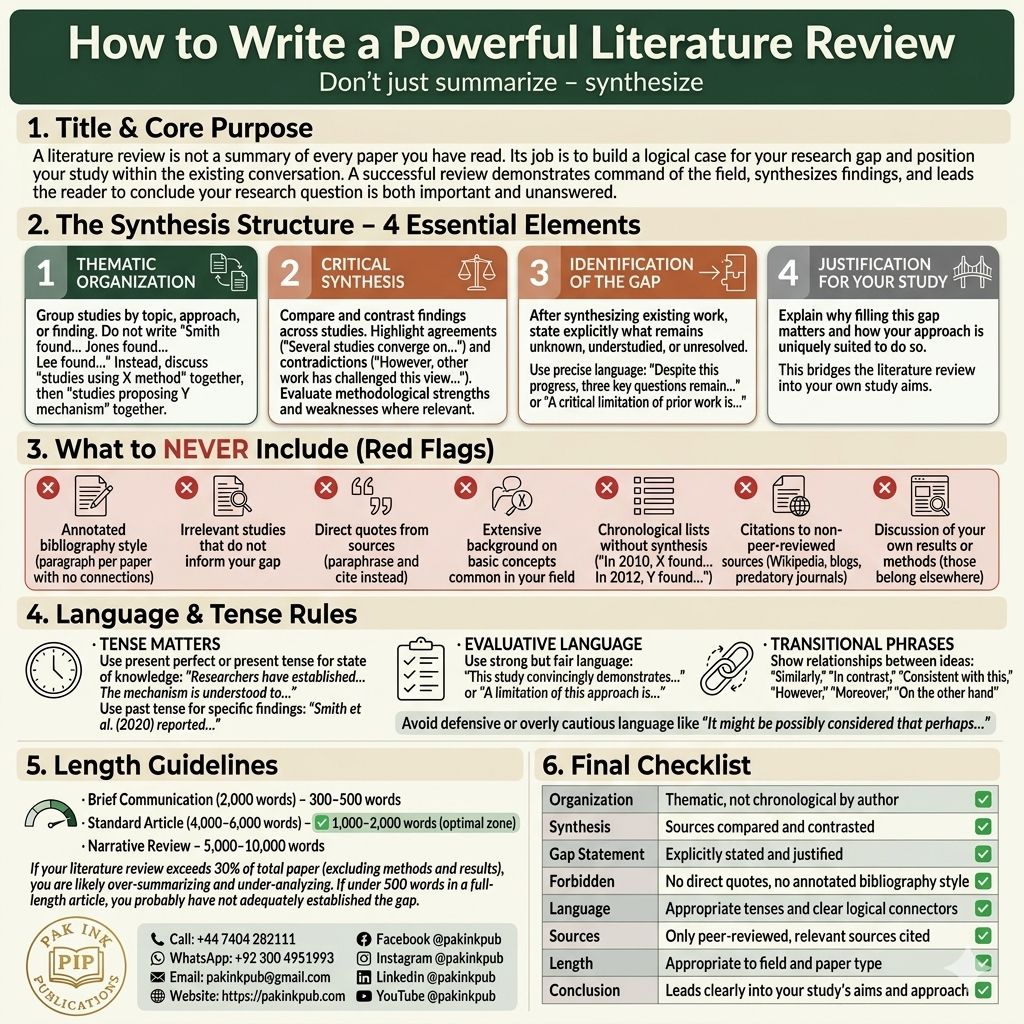
The literature review is not a summary of every paper you have read. Its sole job is to build a logical case for your research gap and to position your study within the existing conversation. A successful literature review demonstrates your command of the field, synthesizes findings (rather than listing them), and leads the reader inexorably to the conclusion that your research question is both important and unanswered.
What MUST Be in a Good Literature Review (The Synthesis Structure)
A strong literature review is organized by themes or debates, not by chronological list of authors. It should contain four essential elements. 1) A Thematic Organization: Group studies by topic, approach, or finding. For example, discuss “studies using X method” together, then “studies proposing Y mechanism” together. Do not write “Smith (2018) found… Jones (2019) found… Lee (2020) found…” 2) A Critical Synthesis: Compare and contrast findings across studies. Highlight agreements (“Several studies converge on…”) and contradictions (“However, other work has challenged this view, showing…”). Evaluate methodological strengths and weaknesses where relevant. 3) Identification of the Specific Gap: After synthesizing existing work, state explicitly what remains unknown, understudied, or unresolved. Use precise language: “Despite this progress, three key questions remain unanswered…” or “A critical limitation of prior work is…” 4) A Justification for Your Study: Explain why filling this gap matters and how your approach is uniquely suited to do so. This bridges the literature review into your own study aims.
What MUST NOT Be in a Good Literature Review
No annotated bibliography style (i.e., one paragraph per paper with no connection between them). No irrelevant studies that do not directly inform your gap. No direct quotes from sources (paraphrase and cite instead). No extensive background on basic concepts that are common knowledge in your field. No discussion of your own results or methods (those belong elsewhere). No citations to non-peer-reviewed sources like Wikipedia, blog posts, or predatory journals unless absolutely justified. No chronological lists without synthesis (e.g., “In 2010, X found… In 2012, Y found… In 2015, Z found…”). No over-citation of the same author or lab without acknowledging broader work.
What Kind of Language Should Be Used?
Use present perfect or present tense for the state of knowledge (e.g., “Researchers have established…”, “The mechanism is understood to…”). Use past tense for specific findings of individual studies (e.g., “Smith et al. (2020) reported…”). Use strong but fair evaluative language: “This study convincingly demonstrates…” or “A limitation of this approach is…” Avoid defensive or overly cautious language (e.g., “It might be possibly considered that perhaps…”). Use transitional phrases that show relationships: “Similarly,” “In contrast,” “Consistent with this,” “However,” “Moreover,” “On the other hand.”
Complementary Elements (What is Often Included or Excluded)
Included are a summary table or figure that organizes key studies by findings, methods, or quality (often placed at the end of the review for longer papers). Also included is a clear statement of how your review was conducted (search terms, databases, inclusion criteria) for systematic reviews or meta-analyses. Excluded from the literature review are any results from your own study, detailed methodological protocols for your own experiment, speculative arguments not grounded in cited work, or personal opinions without evidence.
Length: How Long Should the Literature Review Be?
There is no single answer, as it varies dramatically by field and paper type. For a standard 4,000-6,000 word research article, the literature review (often combined with the introduction) typically runs 1,000-2,000 words. For a narrative review article, the literature review is the entire paper and can be 5,000-10,000 words. For a systematic review or meta-analysis, the literature review includes detailed methods and can be substantial. For a short brief communication, the literature review may be just 300-500 words integrated into a condensed introduction. A good rule of thumb: if your literature review takes up more than 30% of the total paper (excluding methods and results), you are likely over-summarizing and under-analyzing. If it is under 500 words in a full-length article, you probably have not adequately established the gap.
Summary Checklist for a High-Quality Literature Review
Element Requirement
Organization is thematic, not chronological by author. Sources are synthesized, comparing and contrasting findings. The gap is explicitly stated and justified. No direct quotes, no annotated bibliography style. Language uses appropriate tenses and clear logical connectors. Only peer-reviewed, relevant sources are cited. Length is appropriate to field and paper type (typically 1,000-2,000 words for a standard article). Concludes by clearly leading into your study’s aims and approach.