The Core Purpose
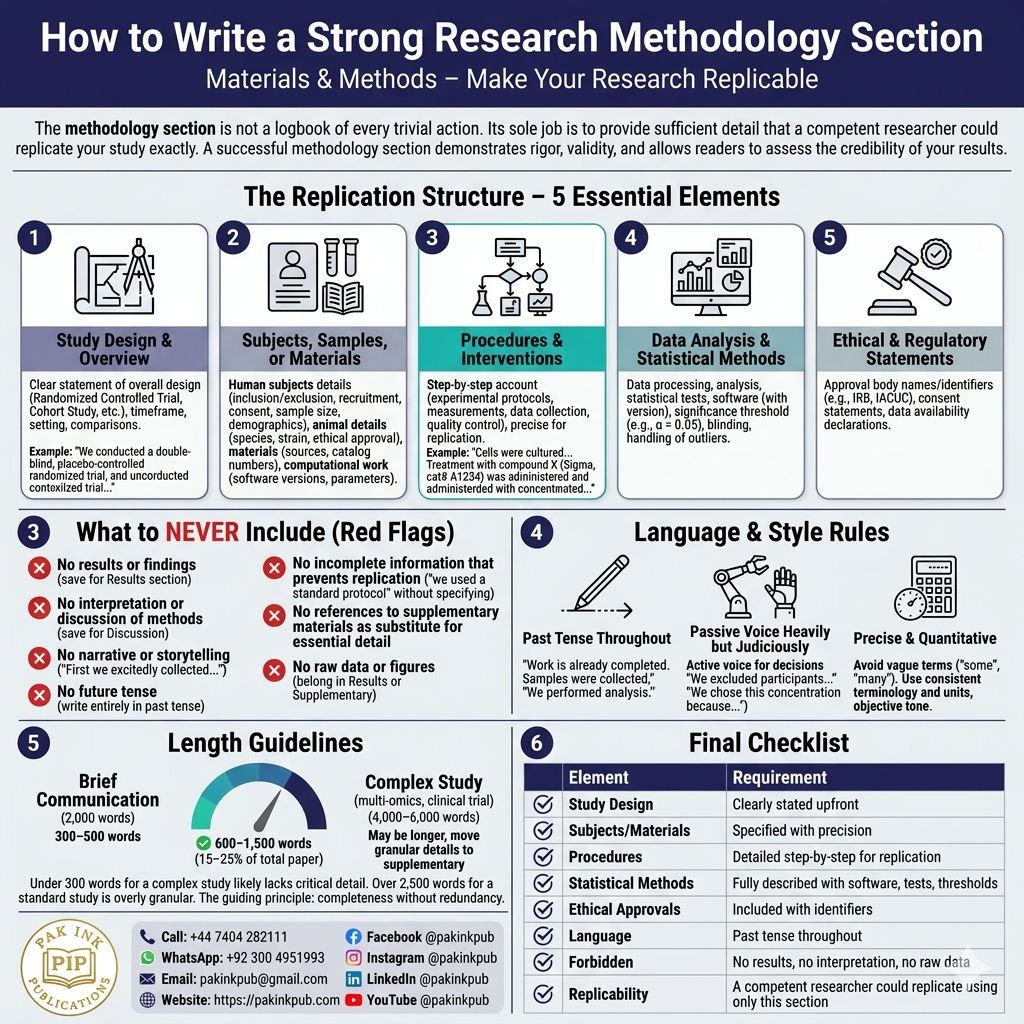
The methodology section is not a logbook of every trivial action you took. Its sole job is to provide sufficient detail that a competent researcher could replicate your study exactly. A successful methodology section demonstrates the rigor and validity of your approach, justifies your choices, and allows readers to assess the credibility of your results.
What MUST Be in a Good Methodology Section (The Replication Structure)
A strong methodology section is organized logically, typically following the flow of the study or grouped by technique. It should contain five essential elements. 1) Study Design & Overview (1-2 paragraphs): Begin with a clear statement of the overall design. Is it a randomized controlled trial? A cohort study? A qualitative interview study? A computational model? State the timeframe, setting, and key comparisons. Example: “We conducted a double-blind, placebo-controlled randomized trial with parallel assignment over 12 weeks at three tertiary care centers.” 2) Subjects, Samples, or Materials (1-2 paragraphs): Describe exactly what was studied. For human subjects: inclusion and exclusion criteria, recruitment methods, consent procedures, sample size justification (power analysis), and demographic summary. For animals: species, strain, sex, age, housing conditions, ethical approval. For materials: sources, catalog numbers, preparation methods. For computational work: software versions, parameters, data sources, code availability. 3) Procedures & Interventions (2-4 paragraphs): Provide a step-by-step account of what you did, in chronological or logical order. Detail experimental protocols, interventions, measurements, data collection methods, and quality control procedures. Be precise enough for replication. Example: “Cells were cultured in DMEM supplemented with 10% FBS at 37°C with 5% CO2. Treatment with compound X (Sigma, cat# A1234) was administered at concentrations of 1, 10, and 100 µM for 24 hours.” 4) Data Analysis & Statistical Methods (1-2 paragraphs): Describe exactly how data were processed, analyzed, and interpreted. State the statistical tests used, software (with version), significance threshold (e.g., α = 0.05), adjustments for multiple comparisons, handling of outliers, and any transformations or normalizations. Include who was blinded and how. 5) Ethical & Regulatory Statements (brief, often separate): For human or animal research, include approval body names and identifiers (e.g., IRB, IACUC), consent statements, and declarations of data availability or preregistration where applicable.
What MUST NOT Be in a Good Methodology Section
No results or findings (save those for the Results section). No interpretation or discussion of what the methods mean (save for Discussion). No justification that belongs in the introduction (e.g., why the study is important) unless it directly justifies a methodological choice. No narrative or storytelling (e.g., “First we excitedly collected the samples and then we carefully ran the assay”). No incomplete information that prevents replication (e.g., “we used a standard protocol” without specifying which one). No references to supplementary materials as a substitute for essential detail (key methods must be in the main text). No brand names without generic equivalents unless the brand is essential to the method. No future tense (write entirely in past tense, as the work is already done). No raw data or figures (those belong in Results or Supplementary).
What Kind of Language Should Be Used?
Use past tense throughout, as the work has already been completed (e.g., “Samples were collected,” “We performed analysis”). Use passive voice heavily but judiciously; active voice is acceptable for decisions or actions taken (e.g., “We excluded participants who…” or “We chose this concentration because…”). Be precise and quantitative: avoid vague terms like “some,” “many,” or “a sufficient amount.” Use consistent terminology and units throughout. Maintain an objective, neutral tone without evaluative language (e.g., “samples were analyzed” not “samples were carefully analyzed”).
Complementary Elements (What is Often Included or Excluded)
Included are details on sample size justification (power analysis), randomization procedures, blinding methods, preregistration links (e.g., ClinicalTrials.gov, Open Science Framework), and statements on code and data availability. Also included are subsections with clear headings (e.g., “Participants,” “Study Design,” “Statistical Analysis”) for readability. Excluded from the methodology section are any results, discussion, literature citations except to justify a specific established protocol (e.g., “as previously described by Smith et al.”), and extensive theoretical background. Supplementary materials are appropriate for detailed protocols, lengthy questionnaires, or code repositories, but the main methods must stand alone.
Length: How Long Should the Methodology Section Be?
The methodology section typically comprises 15-25% of the total paper length. For a standard 4,000-6,000 word research article, this means 600-1,500 words. For a methodologically complex study (e.g., multi-omics, clinical trial, computational modeling), it may be longer. For a short brief communication, it may be condensed to 300-500 words. Unlike the introduction, there is no strict upper limit if every detail is necessary for replication. However, a methodology section under 300 words for a complex study likely lacks critical detail; one over 2,500 words for a standard study may be overly granular and should move some details to supplementary materials. The guiding principle is completeness without redundancy.
Summary Checklist for a High-Quality Methodology Section
Element Requirement
Study design is clearly stated upfront. Subjects, materials, and sources are specified with precision. Procedures are detailed step-by-step for replication. Statistical methods are fully described with software, tests, and thresholds. Ethical approvals and consent statements are included. Past tense used throughout. No results, no interpretation, no raw data. Precision and completeness prioritized over brevity. Length is appropriate to complexity (typically 600-1,500 words for a standard article). A competent researcher in your field could replicate the study using only this section.